Core NW3 · Guide four of four
Swiss Cottage
The one that is not a village. A junction created by an Act of Parliament, named after a pub, with a listed Basil Spence library at its centre and the best transport of the four. Which is also why it is the best value.
- Postcodes
- ThreeParts of NW3, NW6 and NW8, bounded by five conservation areas
- Conservation area
- Since 1988Renamed South Hampstead in February 2011
- Article 4 direction
- June 2026Amended direction. Covers chimneys and rooflights
- Station
- JubileeZone 2, and the fastest route into the West End and the City
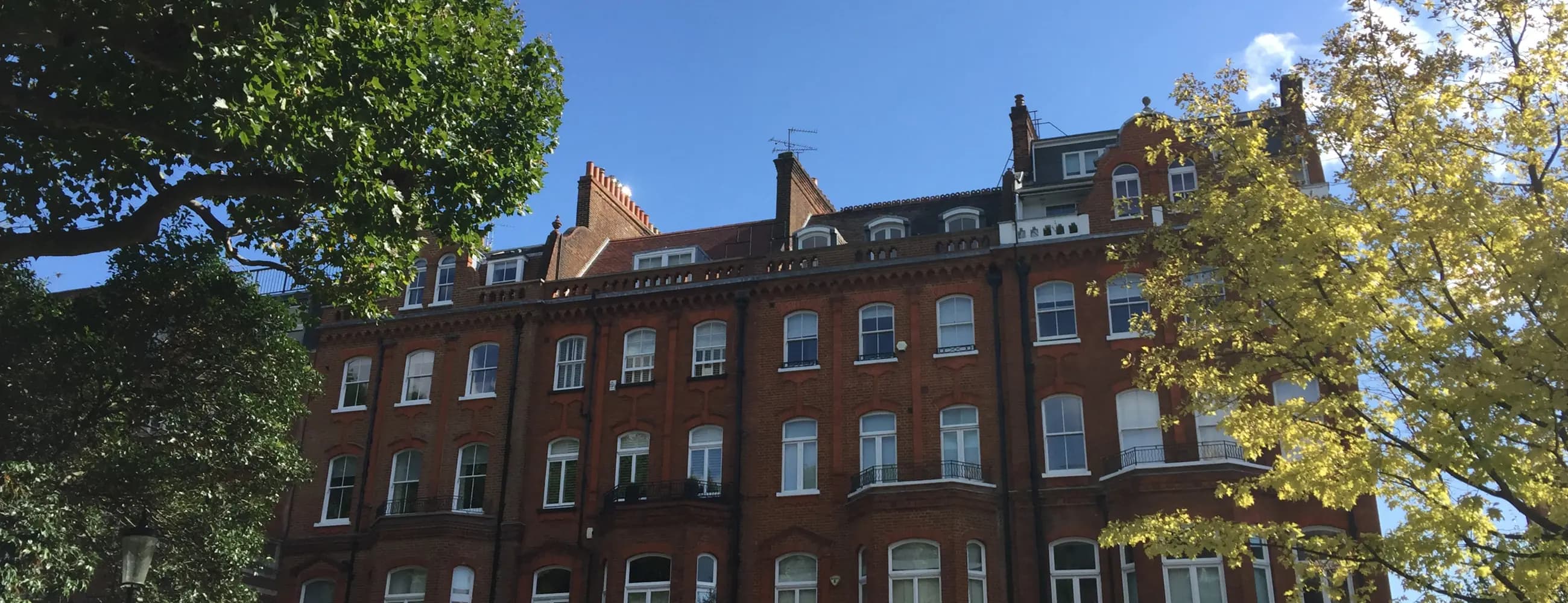
Late Victorian red brickBuilt out between about 1879 and 1900: red brick with terracotta, gables and tall chimneys, and a roofscape that is one of the area’s defining features. The Article 4 direction covers the front elevation precisely because that detail disappears quietly.
Every factual claim on this page was verified against a primary source on .
Camden Council · conservation areas, Article 4 directions, admissions, parkingDepartment for Education · every named schoolHistoric England · listed buildings and gradesGreater London Authority · protected viewsOffice for National Statistics · the price figures
Planning rules change. Camden replaced three of its Article 4 directions in June 2026. Anything on this page that turns on a planning instrument should be confirmed against the current one before you act on it.
Streets and characterLate Victorian red brick, and a great deal more of it than people expect.
Four sub areas, twenty years of building, and an Article 4 direction amended in June 2026
The conservation area covering most of residential Swiss Cottage has a name that catches people out. It was designated on 15 November 1988 as the Swiss Cottage Conservation Area, and Camden renamed it South Hampstead in February 2011, to reflect the area's development and its historic relationship with Hampstead. The place is still called Swiss Cottage. The designation is not, and searches under the old name will miss things.
The building period is tight and it shows. Most of the stock went up between about 1879 and 1900: large semi-detached and terraced houses, red brick with yellow stock brick on the secondary elevations, terracotta panels, slate and clay tile roofs, ornate ironwork and decorative brickwork. The roofscape is the giveaway, all turrets, gables and tall chimneys. Banister Fletcher the elder, 1833 to 1899, lived on the corner of Woodchurch Road and West End Lane and designed several of the houses nearby, including 82 Compayne Gardens and 5 Cleve Road. Neither is statutorily listed; both sit within the conservation area. Note this is the father, not his son Sir Banister Flight Fletcher, with whom he wrote A History of Architecture on the Comparative Method.
Houses sit back from the pavement behind green front gardens with low or ornate walls topped by hedges. Camden's appraisal treats the rear gardens and communal spaces as significant in their own right, describing them as wildlife corridors, which is one reason applications to build across them do not go smoothly.
Four sub areas
East of Fairhazel Gardens holds the mansion blocks and the tighter terracing nearest Finchley Road. The central wedge, Aberdare, Broadhurst, Canfield, Compayne and Greencroft Gardens, is described in the appraisal as the heart of the conservation area and carries the most ornate properties. The Colonel Cotton zone west of Priory Road is different again, detached mid-Victorian houses with Classical detailing. Belsize Road is earlier still, stucco Italianate, shading into the neighbouring Priory Road conservation area.
What you may change
An Article 4(1) direction of September 2010, amended with effect from 9 June 2026, applies to the majority of properties, though not to all of them. It requires planning applications for front alterations including windows, doors and decorative details, front painting where it differs from the traditional finish, roof additions and alterations including rooflights, chimney work, hard surfacing at the front, and changes to front gates, walls and fences. Repair or replacement in matching materials is exempt.
Camden replaced three of its conservation area directions on the same date, so anything citing the 2010 instrument alone is now out of date. This one covers rooflights and chimney work, which matters a great deal in an area whose roofline is the thing the appraisal singles out. Do not assume what applies on one side of Finchley Road applies on the other.
Planning position as at 4 September 2026
Most of residential Swiss Cottage sits in the South Hampstead Conservation Area, designated in 1988 as Swiss Cottage and renamed in February 2011. The stock is mostly late Victorian, built between about 1879 and 1900, in red brick with terracotta, under a roofscape of turrets, gables and tall chimneys. An Article 4 direction of September 2010, amended from 9 June 2026, covers front alterations, roof additions, rooflights and chimney work on the majority of properties, though not on all of them.
- Compayne GardensIn the central wedge, the heart of the conservation area. Number 82 is by Banister Fletcher the elder.Central wedge
- Canfield GardensOrnate late-Victorian terracing, one of the best runs in the area.Central wedge
- Greencroft GardensSame period and idiom, largely converted to flats.Central wedge
- Broadhurst GardensRuns east to west through the wedge towards Finchley Road.Central wedge
- Aberdare GardensQuieter than its neighbours, and correspondingly sought after.Central wedge
- Fairhazel GardensThe dividing line. Mansion blocks and tighter terracing to its east.Sub area boundary
- Priory RoadWest of it, detached mid-Victorian houses with Classical detail.Colonel Cotton zone
- Cleve RoadNumber 5 is another Banister Fletcher the elder house. Unlisted, within the conservation area.South Hampstead CA
- Goldhurst TerraceLong run, mixed condition, a great deal of it in flats.South Hampstead CA
- Belsize RoadEarlier stucco Italianate, transitional towards the Priory Road area.Belsize Road zone
- Finchley RoadThe spine. Shops, the station, the traffic, and the reason the area works.Boundary
The junctionA place named after a pub, built around an Act of Parliament.
1804, 1826, and a listed Basil Spence library at the centre of it
The other three guides describe villages that London grew around. This one is different, and being straight about that is more useful than pretending otherwise.
Swiss Cottage is a junction, and it is named after a pub. A tavern was built in 1804 in the style of a Swiss chalet, on the site of a former tollgate keeper's cottage. The Finchley Road Act of 1826 then authorised two new roads, Finchley New Road and Avenue Road, and the tavern stood at the point where they met. The district took its name from the building, and the roads brought everything else.
Nothing about that is a disadvantage, and it explains the character precisely. This is the part of NW3 that was made by infrastructure rather than by a village green, which is why it has the best transport of the four, the most shops, the civic buildings, and the lowest prices.
The civic centre
At its heart is a genuinely important twentieth century building. Swiss Cottage Library was built in 1963 to 1964 by Sir Basil Spence, Bonnington and Collins for the Borough of Hampstead, and it has been Grade II listed since 2 December 1997. Historic England calls it one of Spence's most accomplished civic buildings, and among the most ambitious library designs found anywhere.
Alongside it sit the leisure centre, the open space, and Hampstead Theatre. For a buyer with children, or anyone who actually uses a library and a swimming pool, this concentration is worth more than it usually gets credit for in the particulars.
A tavern built in 1804 in the style of a Swiss chalet, on the site of a tollgate keeper's cottage, gave the district its name. The Finchley Road Act of 1826 created the two roads that meet beside it. Swiss Cottage was made by infrastructure rather than by a village, which is why it has the best transport of the four areas and the lowest prices.
- Swiss Cottage Library Basil Spence, Bonnington and Collins, 1963 to 1964 Grade II
- Hampstead Theatre Beside the station, at the western end of Eton Avenue Civic
- Leisure centre Pool and gym, part of the same civic cluster Civic
- The Swiss Tavern Built 1804 in the style of a Swiss chalet, and the origin of the name 1804
- Finchley Road Act 1826, authorising Finchley New Road and Avenue Road 1826
Swiss Cottage spans three postcodes, NW3, NW6 and NW8, and is bounded by five separate conservation areas. Two houses a few streets apart can carry different postcodes, which affects how each is perceived even where the buildings are identical. It is worth establishing which one an address falls in before forming a view on price.
Schools and admissionsBetter placed than the price would suggest.
The same independent schools as Hampstead, from a cheaper address
This is where Swiss Cottage quietly does well. It sits within reach of the same independent schools that people pay Hampstead prices to be near, and it has good state provision of its own, at a materially lower cost of entry.
South Hampstead High School is on the doorstep, and University College School is a short run north. For a family whose plan runs through the independent sector, the argument for paying a Hampstead premium to be a few minutes closer is not a strong one.
On the state side, the picture is complicated by the borough boundary as much as by distance. Parts of the area fall towards Camden's western edge, and neighbouring authorities run their own admissions and their own rules. Establish which authority an address sits in before you rely on anything, rather than assuming the Camden position applies. Camden itself operates no catchment areas apart from Abacus Belsize Free School's, only a published record of the furthest child offered a place at each school in the last round.
Admissions position as at 4 September 2026
As everywhere in this part of London, nothing should be treated as settled. Camden and its neighbours publish the actual last distance offered for each school each year, and that figure is the only one worth planning around.
Swiss Cottage reaches the same independent schools as Hampstead from a cheaper address, with South Hampstead High School on the doorstep and University College School a short run north. On the state side the borough boundary matters as much as distance, so establish which authority an address falls in rather than assuming Camden's rules apply. Camden itself has no catchment areas apart from Abacus Belsize Free School's, only a published record of last year's furthest offer.
- South Hampstead High School Girls, 4 to 19. In the area Selective
- University College School Boys 4 to 16, co-ed sixth form. Frognal Selective
- The Hall School Boys, 4 to 13 Selective
- Devonshire House Mixed, 2 to 13 Selective
- The UCL Academy Mixed, 11 to 18. Adelaide Road Proximity
- Parliament Hill School Girls at 11. Mixed LaSWAP sixth form Proximity
- William Ellis School Boys at 11. Mixed LaSWAP sixth form Proximity
- La Sainte Union Catholic Girls at 11. Mixed LaSWAP sixth form Catholic first
- Fitzjohn’s Primary School Mixed, 3 to 11. Community Proximity
- Christ Church Primary School, Hampstead Mixed, 4 to 11 CofE, parish first
- Hampstead Parochial CofE Primary Mixed, 4 to 11 CofE, half faith
Phase, age range and gender of intake as recorded by the Department for Education. Camden operates no catchment areas, apart from Abacus Belsize Free School's. Admission arrangements, published distances and fees change every year, and parts of this area sit close to a borough boundary. Check the current position with the relevant authority and with each school directly before you rely on it.
Transport and parkingThe best connected of the four, and it is not close.
The Jubilee line, two more stations within walking distance, and Camden permits
Swiss Cottage is on the Jubilee line, in zone 2, and that is the single biggest practical advantage it holds over the other three areas. The Jubilee runs to Bond Street, Westminster, London Bridge and Canary Wharf on one line, with no changes and modern rolling stock. For anyone commuting to the City or the Wharf, it is not a close contest.
The station opened on 20 November 1939 as part of a new deep-level tunnel section. A Metropolitan line station of the same name shared the site until it closed on 17 August 1940, which is why the surface arrangement can look slightly odd to anyone who knows the history.
Finchley Road is a short walk north and adds the Metropolitan line and the Overground. South Hampstead on the Overground and Belsize Park on the Northern line are both within reach on foot. Very few addresses in NW3 have three lines and an Overground within a walk.
Parking
Camden controlled parking zones apply, and permits are priced by the length of the permit, the vehicle’s CO2 emissions band and its fuel type, with a further air quality surcharge on older petrol and diesel vehicles. You must be the registered keeper and live at the address at least five nights a week, and car free housing is not eligible, which affects a good number of the newer flats near the junction.
Two local wrinkles. Permits are valid in your own zone only, and with three postcodes and five conservation areas meeting here the zones do not follow the way people describe the area. And the Article 4 direction covers hard surfacing at the front, so creating a space where none exists is a planning matter rather than a weekend job.
Swiss Cottage station is on the Jubilee line in zone 2, which reaches Bond Street, Westminster, London Bridge and Canary Wharf without a change. It opened on 20 November 1939. Finchley Road adds the Metropolitan line and the Overground a short walk north, with South Hampstead and Belsize Park also walkable. Street parking needs a Camden resident permit, valid only in your own zone.
- Swiss Cottage Jubilee line, opened 1939 Zone 2
- Finchley Road Jubilee and Metropolitan lines Zone 2
- Finchley Road & Frognal London Overground Zone 2
- South Hampstead London Overground Zone 2
- Belsize Park Northern line, walkable to the east Zone 2
Hampstead sits on the Northern line's Edgware branch, which is slow into the City and requires a change. Swiss Cottage is one Jubilee line ride to Canary Wharf. For a buyer whose journey is eastward, that difference is worth more than the postcode.
What things sell forThe best value of the four, and the reasons are structural.
Why the same money buys more here, and what to watch for when it does
Swiss Cottage is consistently the cheapest of the four areas, and the reasons are structural rather than a comment on quality. It has no village green and no protected common. It carries a great deal of traffic on Finchley Road. Its housing stock is later and more uniform. And its name attaches to a junction rather than to a village.
None of that makes the houses worse. The late-Victorian stock here is generous, well built and frequently more practical than the older housing further up the hill, and the transport is better. What it means is that the same money buys more, which is exactly why the area rewards buyers who care about what a house is rather than what an address signals.
In descending order, value sits with intact houses in the central wedge and the detached houses west of Priory Road, then lateral conversions in the large late-Victorian houses, then mansion block flats towards Finchley Road, then upper conversions without a lift, and then anything fronting Finchley Road itself, which carries a real and permanent discount for noise.
The premiums are the usual ones with a local twist. Distance from Finchley Road, measured in streets rather than minutes. A quiet position within the central wedge. An intact roofscape, because the Article 4 direction covers chimneys and rooflights and the appraisal treats that roofline as central to the area's character, so a house that has kept its chimneys is worth more than one that has not. Genuine outside space. And a long lease or share of freehold, since so much of the stock is converted.
The discounts: Finchley Road frontage, short leases, a front elevation carrying unconsented work, and anything where a rooflight or chimney alteration has been made without permission, which is a specific and common problem here rather than a theoretical one.
Figures, London Borough of Camden
- Detached £3,606,000
- Semi-detached £2,125,000
- Terraced £1,569,000
- Flats and maisonettes £688,000
- All property types £833,000
Live: sales on this guide’s streets
- Sales in the 12 months to August 2026 61
- Median price, all sales £641,000
- Flats and maisonettes, median of 57 £630,000
Everything factual on this page comes from a primary source, and all of them are public. The conservation area, its four sub areas, the Article 4 direction, admissions and parking zones: Camden Council. The library's listing: Historic England's National Heritage List. Prices: the Office for National Statistics and HM Land Registry.
Common questionsSeven things people ask before they view.
Short, sourced answers on the name, the designation, the postcodes and the planning rules
Why is the conservation area called South Hampstead and not Swiss Cottage?
Because Camden renamed it. It was designated on 15 November 1988 as the Swiss Cottage Conservation Area and renamed South Hampstead in February 2011, to reflect the area's historical development and its spatial and historic relationship with Hampstead. The place is still called Swiss Cottage. The designation is not.
Where does the name Swiss Cottage come from?
From a pub. A tavern was built in 1804 in the style of a Swiss chalet, on the site of a former tollgate keeper's cottage. The Finchley Road Act of 1826 authorised Finchley New Road and Avenue Road, and the tavern stood at their junction, which is how the whole district came to be named after it.
What sort of houses are in Swiss Cottage?
Predominantly late Victorian, built between about 1879 and 1900: large semi-detached and terraced houses in red brick, with yellow stock brick on secondary elevations, terracotta panels, slate and clay tile roofs and decorative brickwork. The roofscape of turrets, gables and tall chimneys is one of the defining features. Banister Fletcher designed several houses here, including 82 Compayne Gardens and 5 Cleve Road.
Do I need permission to alter a house in Swiss Cottage?
On most properties in the South Hampstead Conservation Area, yes, though not on all of them. An Article 4(1) direction of September 2010, amended with effect from 9 June 2026, requires planning applications for front alterations including windows, doors and decorative details, front painting where it differs from the traditional finish, roof additions and alterations including rooflights, chimney work, hard surfacing at the front and changes to front gates, walls and fences. Repair or replacement in matching materials is exempt.
Which postcode is Swiss Cottage?
It spans three. Parts of Swiss Cottage fall in NW3, NW6 and NW8, and the area is bounded by five separate conservation areas. Two addresses a few streets apart can carry different postcodes, which affects how they are perceived even where the housing is identical.
Which line serves Swiss Cottage station?
The Jubilee line, in zone 2, between Finchley Road and St John's Wood. The station opened on 20 November 1939 as part of a new deep-level tunnel section. A Metropolitan line station of the same name shared the site until it closed on 17 August 1940.
Is Swiss Cottage Library a listed building?
Yes, Grade II, listed on 2 December 1997. It was built in 1963 to 1964 by Sir Basil Spence, Bonnington and Collins for the Borough of Hampstead. Historic England describes it as one of Spence's most accomplished civic buildings and among the most ambitious library designs found anywhere.
Thinking of selling in Swiss Cottage?
An honest figure based on what has actually sold on your street this year, not a number designed to win the instruction and then be reduced in six weeks. Valuation, viewings, negotiation and progression, all with the same person.
Tessa will get back to you as soon as possible.